
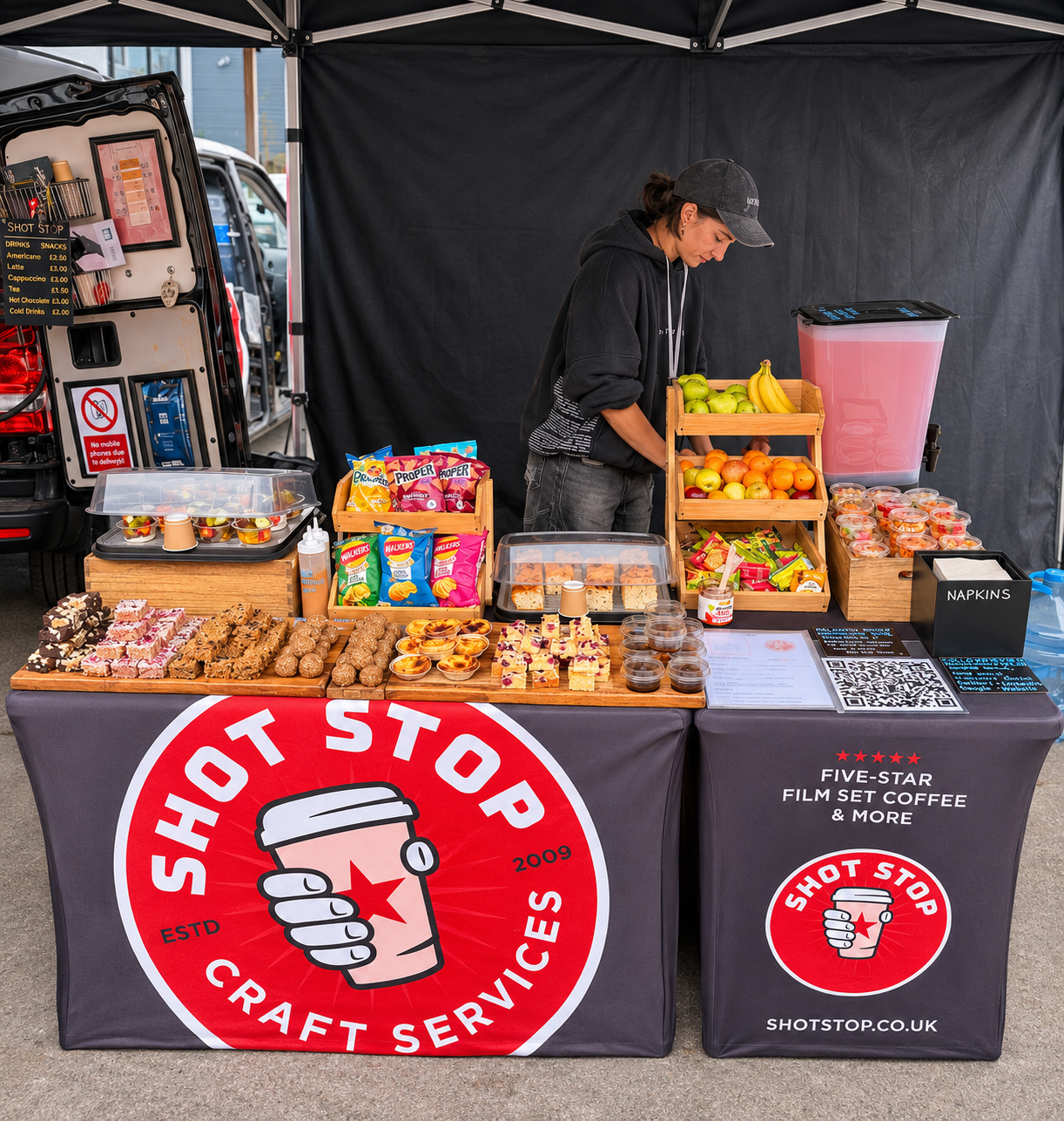
Crafty Table Set Up With Afternoon Sweet Treats
What is craft services? Craft services, known on set as "crafty", is the drinks, snacks and refreshments operation that runs alongside filming for the whole shooting day. It isn't the same as unit catering, which serves scheduled full meals. Crafty fills the gaps: before the morning break, between meals and long after lunch, keeping cast and crew fed and watered without anyone having to stop work to go looking. The crafty team is usually first on set and last off it.
On a UK film set, craft services can mean anything from a tea urn and a packet of biscuits on a low-budget short to a staffed, self-powered operation running for months on a major Netflix drama. We've been doing the second kind since 2009. Shot Stop has looked after crews on more than 150 productions, from one-day commercials on tight London streets to The Witcher series 2 to 5, which ran for about six months a series.
This guide covers what craft services includes, how it compares to unit catering, what ends up on a craft table, who runs it, what affects the cost, and a little on the crafty role itself.
Key takeaways
Crafty is not catering: craft services provides continuous between-meal drinks and snacks; unit catering produces scheduled full meals. They're separate operations with separate budgets.
Set-up starts early: a craft services team is usually set up well before crew call (how early depends on the production) and stays until the last person leaves. If site power isn't on yet, a self-powered set-up means the coffee still is.
Dietary planning is non-negotiable: UK sets collect dietary requirements, and every item needs clear allergen labelling or allergen information to hand. Vegetarian, vegan, gluten-free and other diet-specific options should be there as a matter of course, not as an afterthought.
Albert matters: productions working towards BAFTA albert certification should ask craft suppliers what they actually do about cups, packaging, milk, waste and vehicles, and pick ones who can answer properly.
What is craft services on a film or TV set?
A craft services team is usually set up well before crew call; how early depends on the production and its call times. By the time the first department heads walk in, the coffee should be on, water chilled and the first snacks out. From then until the last person leaves, the crafty team is restocking, rotating food, keeping the station tidy, labelling allergens and packing everything up when the unit moves. There's no service window. The station is just there. If site power isn't ready at pre-call, we run off a suitcase generator where the location allows, then switch to the production's supply once it's live.
Why crafty matters more than people expect
On a 12-hour day, the craft table is what stands between a focused crew and one that keeps drifting off to find water or a coffee. The fewer times crew leave their position, and the shorter the walk when they do, the tighter the schedule.
This is why we built Shot Stop around small vehicles. Our two Mercedes Vito vans and Caesar, a Piaggio Ape small enough to be pushed into place by hand (he arrives on a trailer), let us set up much closer to set than a big craft truck can. Less walking to craft means less time off set. Where there's nowhere to put a vehicle at all, the pop-up bar goes indoors: when Westminster rules kept vehicles off the street on The Diplomat, we set up inside the Foreign Office.
Who is the crafty accountable to on set
Craft services works alongside the catering department, not inside it. The team coordinates with the assistant directors around meal-break timing and answers to production management. In practice that means crafty fits around the AD's schedule rather than setting its own, and adjusts quickly when call times shift or the unit moves mid-week. On long runs it also means covering more than one unit: on The Witcher series 5 we had two Vitos covering main and 2nd unit, for crews of up to 600.
What you'll find on the craft table: menus and dietary provisions
A well-stocked craft table follows the rhythm of the day. Pre-call is coffee, tea, water, fruit, breakfast pastries, cereal bars and packaged snacks. Mid-morning brings savoury items: mini sandwiches, sausage rolls, freshly baked focaccia, hummus and crudites, vegan protein balls. After lunch, it's sweet treat time: biscuits, flapjacks, delicious cakes, shortbread, chocolate including a couple of heathier options to sustain energy levels throughout the rest of the shift.
On long days and night shoots, hot snacks earn their place: soup, croque monsieur, sausage rolls. Our newest van, Sonny, has a pie warmer for exactly this.
In order to prioritise variety we recommend offering grazing tables on longer shoots: hand-made sweet and savoury, hot and cold bites, replenished through the day. We ran them on The Diplomat series 2 to 4 and on Elden Ring, which was a 14-week shoot. The key to a successful long run is keeping it interesting, so that week ten doesn't taste like week one. Snacks and grazing tables need at least 48 hours' notice, because everything is cooked and prepared fresh to order.
Dietary requirements and allergen labelling
UK sets collect dietary requirements from cast and crew before filming starts, and the craft services team should cater for vegetarian, vegan, gluten-free, dairy-free and nut-allergy needs as standard, plus anything else that comes up. Allergy-safe food should be kept separate, clearly labelled, and as substantial as everything else on the table.
This isn't box-ticking. UK food law requires allergen information for the food you supply, and that applies on set as much as in a café (see the FSA's food allergen labelling and information requirements technical guidance). Getting allergen labelling wrong can stop a shoot. Getting it right is how a crafty team earns the crew's trust.
Here's how we handle it. We're a nut-free supplier: we don't keep nuts in stock and we check supplier labels. Oat, coconut and soya milks sit alongside dairy, and vegan and gluten-free options are included each day. Some of our sweet and savoury snacks are produced in external kitchens. In addition to any highlighted ingredients, these products may contain traces of other allergens due to manufacturing cross-contamination risks. If crew need to check specific third-party supplier information, they should speak to the food server on duty.
Health & hygiene should be strictly monitored and adhered to and in the UK craft suppliers will be able to provide you with a rating provided by their local borough council’s environmental health department. We are proud to display our 5 star rating following an inspection in September 2026.
How does craft services differ from unit catering?
They are two completely different operations on set
Craft services and unit catering run in parallel, not instead of each other. Craft services is continuous between-meal snacks, coffee and refreshments, available from crew call through to wrap and accessible between takes. Unit catering produces and serves scheduled full meals: breakfast, lunch and, on long days, a second meal. The simplest way to remember it: craft services is always open; catering has a service window.

When the lines blur, and why that matters
On smaller productions one team may cover both. On bigger shoots, craft services and catering tend to be separate suppliers with separate budgets. If you're budgeting a production for the first time, treat them as two line items with different jobs, and if you think you'll need a second meal from craft, check who will cover it when you get quotes, because it changes staffing and cost.
Who runs craft services: The key crafty and their team
The key craft services person, usually called the "key crafty", manages the budget, plans the menu, keeps track of dietary requirements and leads the logistics through company moves. On a small commercial that may be one person doing everything. On a large drama there might be several people, with the key crafty leading prep, purchasing and stock while the others replenish and serve on set. The key crafty is also the one talking to production and the AD team so the operation moves with the shoot rather than falling a step behind it.
On our coffee service, the people on set are trained baristas, all holding at least Level 2 food hygiene. On big days we scale up rather than out: at Longcross we ran two compact set-ups side by side with four baristas for 400 crew at peak, and there's more on how we planned that in Can a compact craft set up serve 400 crew without long queues?
What affects crafty rates
For anyone budgeting, it helps to know how crafty crew are usually paid. It's freelance work, with rates agreed per production. BECTU doesn't publish a dedicated craft services rate card; the Production Coordinator category on BECTU's Scripted Production rate card is the closest published benchmark for coordinator-level roles. Rates move with whether the crafty supplies a vehicle, day length, prep and wrap time, mileage and the production's budget tier, so check what's included before comparing numbers.
How much does hiring craft services cost a UK production?
What pushes the cost up? Crew size is the biggest driver: food, drinks, consumables and waste all scale with headcount. Service levels matter just as much. A self-serve tea-and-snacks station costs far less than staffed service with hot food, dietary alternatives and constant replenishment. London and the South East cost more than regional shoots, and access problems, distance to location, overnight stays, company moves, night shoots and early calls all add to the bill. When you compare quotes, ask for food, labour, equipment, travel and VAT to be itemised separately; a single bundled figure makes a fair comparison impossible.
Length of day is the other lever. Our standard day is eight hours' service, shorter than a full shooting day, so productions choose how long they want us there and can add hours if they need them. It makes the budget easier to manage.
Beyond that, every craft quote is tailored to the production: crew size, menu, dietary needs, location and how long the run is. Tell us what you're planning and we'll put a quote together that fits.
Shot Stop Craft Services: 17 years of on-set experience
Shot Stop was established in 2009 and has worked on more than 150 productions. A lot of that time has been spent on long runs rather than single days. Discover how we’ve supported recent productions on our credits page.
On sustainability, we're proud to be the first craft services supplier to be recognised by albert. For a production working towards BAFTA albert certification, the specifics are what count, so here are ours: home-compostable double-walled paper cups made to EN 13432, no straws, sugar added by the barista so there are no stirrers, cup carriers made from recycled plant-milk cartons, plant milks at every station, spent coffee grounds given free to local farms, and vehicle emissions offset through certified UK tree-planting. It isn't perfect yet, and our sustainability page is honest about what's still to do.
What separates a specialist provider from a generalist
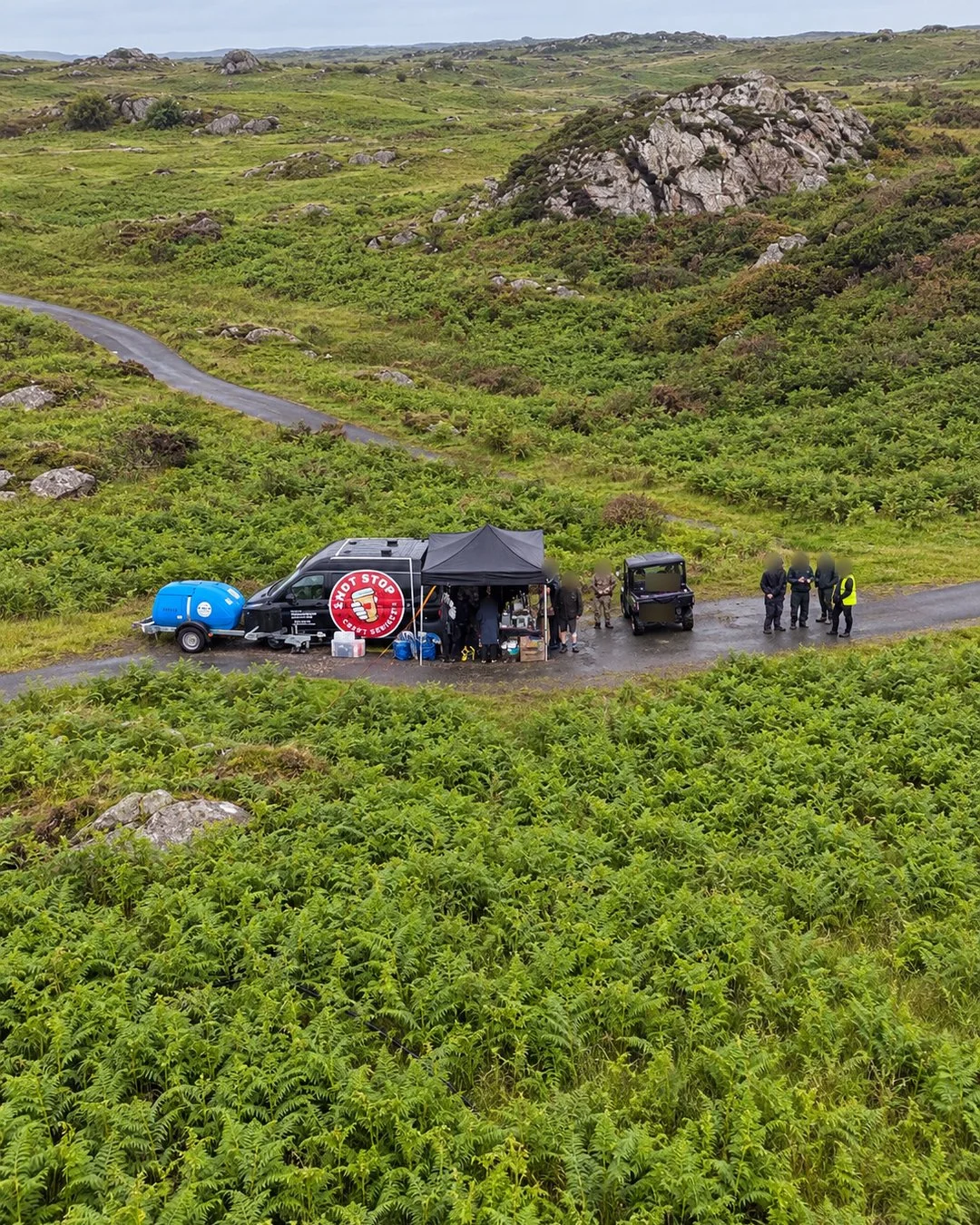
Setting up close to set on a remote moor.
For us, it's getting close to set. Our compact fleet is two Mercedes Vito vans, Sonny and Scarlett, and Caesar the Piaggio Ape, who travels to location on a trailer and can be pushed into place by hand. Between them they fit where a large craft truck struggles. On The Witcher series 4 that meant Arborfield, Longcross, Devon beaches and Welsh slate quarries. On another production it's meant the length of Wales, the Scottish Highlands, the Lake District (including a flooded field) and the Isle of Man, and, when there's nowhere for a vehicle at all, the pop-up bar indoors.
The vans are self-powered when they need to be.
Both Vitos have on-board generators and 100-litre water tanks with a reserve, Caesar runs on LPG and a very quiet suitcase generator, and Sonny's solar panels and battery keep the fridges running overnight. Where possible we plug into the production's supply and keep the generators for remote locations or when there's no power. On long-running productions we also bring Starlink Wi-Fi, which earns its keep where the phone signal gives up; it isn't part of one-day bookings.
On commercials, the usual package is one day, coffee only, with snacks on request. Our standard day is eight hours' service, and you can add additionalt hours if the shoot runs longer. If you're planning a shoot, send us the date, location and crew size and we'll talk it through. We typically reply within the hour; coffee-only jobs can be done on 24 hours' notice if we're free, and anything with snacks needs at least 48 hours.
Craft services is a small department with a massive impact
Understanding what is craft services, and how it differs from unit catering, is useful for any production manager, coordinator or first-time budgeter. Craft services keeps cast and crew supplied between meal breaks, runs from before crew call to after wrap, and needs proper dietary planning, allergen management and logistics at every stage. It has its own budget, its own staffing and its own rhythm within the shooting day. The crafty team is often first on set and last to leave, and how well it's done shows up in crew welfare and in the schedule. If you've more questions, we've answered the common craft services questions production teams ask us.
Whether you're building a budget, working out how a set fits together, or just curious what the key crafty actually does all day, the job is a lot more skilled than "putting the biscuits out" suggests.
With more than 150 productions and 17 years on set behind us, we're happy to talk through what craft services could look like for your shoot. If you're planning a UK production and want a crafty team that keeps up with it, get in touch.